Need for Speed
What a solve costs, where the time goes, and the two tricks worth an order of magnitude.
The price of harmonics
Everything is governed by one number — the harmonic count
for n_orders = (Mx, My). Each patterned layer demands one dense
eigendecomposition of a \(2P \times 2P\) matrix, and the scattering algebra
moves \(2P \times 2P\) blocks around. So, per layer:
Read that cubic again: doubling \(M\) in 2-D quadruples \(P\) and costs you ~64× the time. The consequences, in order of importance:
n_ordersis the throttle. Find the smallest converged value (the ritual) and stop.- 1-D gratings fly economy for free:
n_orders=(M, 0)gives \(P = 2M+1\) — linear, not quadratic. - Uniform layers cost nothing. Their modes are analytic; a thin-film
stack at
n_orders=0is effectively instant.
Indicative single-solve timings
One 2-D solve of a patterned layer, single thread — orders of magnitude, not a contract (your CPU and BLAS will vary):
| \(M\) | harmonics \(P\) | matrix size \(2P\) | time |
|---|---|---|---|
| 5 | 121 | 242 | ~0.1 s |
| 8 | 289 | 578 | ~0.4 s |
| 9 | 361 | 722 | ~1 s |
| 12 | 625 | 1250 | ~4 s |
| 13 | 729 | 1458 | ~8 s |
| 15 | 961 | 1922 | ~20 s |
From \(M=9\) to \(M=13\): \(P\) doubles, time ×8. The cube never sleeps.
How Ikarus stacks up
Head-to-head against the independent
grcwa (both tools fed
byte-identical material data), Ikarus agreed on \(R\), \(T\) and phase to
~10⁻³ while running ~1.5–1.7× faster per solve (729 harmonics: ~8 s vs
~13 s). The margin comes from exploiting identity gap modes
(\(W_0 = I\)), diagonal algebra in homogeneous regions, and
scipy.linalg.solve right-division instead of explicit inverses.
Memory scaling
The heavyweights are \(2P \times 2P\) complex128 matrices — several live per patterned layer at \((2P)^2 \times 16\) bytes apiece:
| \(M\) | \(2P\) | one matrix |
|---|---|---|
| 5 | 242 | ~0.9 MB |
| 8 | 578 | ~5 MB |
| 10 | 882 | ~12 MB |
| 12 | 1250 | ~25 MB |
| 15 | 1922 | ~59 MB |
| 20 | 3362 | ~181 MB |
Budget a handful per layer. Deep stacks at large \(M\): lower n_orders,
or run fewer solves simultaneously.
BLAS threading
The most impactful knob in the whole chapter — and it's two lines.
Tight loops of small solves (sweeps, GA populations): the matrices are too small for threaded BLAS to win; it burns the time spawning and synchronizing threads instead. Pin one thread per process and parallelize at the process level:
import os
for v in ("OMP_NUM_THREADS", "OPENBLAS_NUM_THREADS",
          "MKL_NUM_THREADS", "VECLIB_MAXIMUM_THREADS"):
    os.environ.setdefault(v, "1")
import numpy as np  # noqa: E402 — must come AFTER the env vars
In our testing this made an inverse-design run roughly an order of magnitude faster on a many-core machine. Not a typo.
Large single solves (\(M \gtrsim 20\)): the opposite regime — one eigendecomposition is big enough to feed every core. Let BLAS thread, parallelize coarser. When in doubt, benchmark both; it takes two minutes.
Convergence cheat sheet
| Structure | Typical n_orders |
Notes |
|---|---|---|
| Thin films (uniform) | 0 |
exact, instant |
| Gentle dielectric metasurfaces | 8–12 | TE and TM both quick |
| High-contrast dielectric | 12–18 | verify TM specifically |
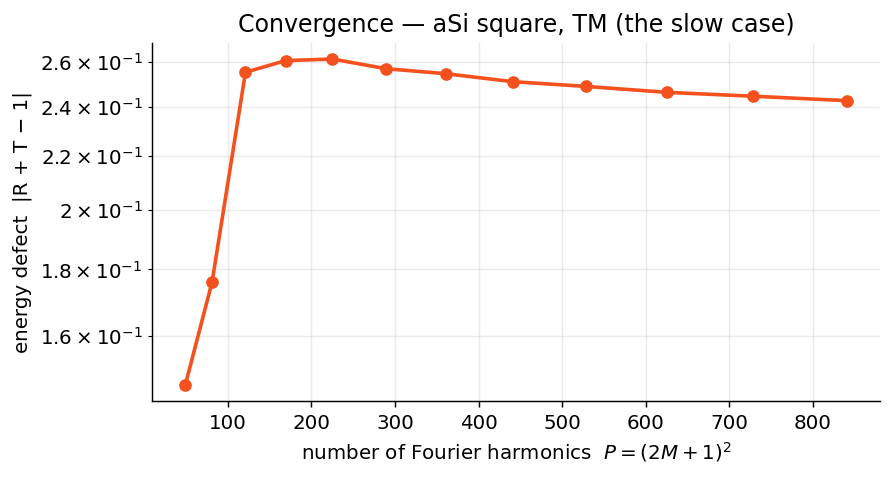
| Metals, TM / p-pol | 18–30+ | the slow lane — see below |
| 1-D gratings | (15–30, 0) |
cheap because 1-D |
Always converge at your worst-case wavelength/polarization, watching that \(R\) and its phase have stopped moving — not \(|R+T-1|\), which a lossless structure satisfies at every truncation.
Normal-vector factorization (default)
Ikarus factors the permittivity with the normal-vector method (Fast
Fourier Factorization) by default (factorization="auto"): the inverse rule
is applied along the true local boundary normal, so sharp
high-contrast/metallic edges and curved boundaries converge fast —
high-contrast TM gratings settle by
\(n_{\text{orders}}\approx 10\text{–}15\) instead of drifting. On
axis-aligned geometry it reduces exactly to Li's inverse rule ("li", the
default through v0.7). It is automatic for any topology and any number of
materials; "li", "laurent" and "normal" remain as explicit overrides
for benchmarking (RCWA → Factorization).
Watch out: for high-contrast TM, \(|R+T-1|\approx 0\) does not prove
convergence — confirm \(R\) and phase have stopped moving with n_orders
(the direct rule can conserve energy while still far from the converged
value).
Accuracy ledger
- Analytic Fresnel/transfer-matrix agreement: ~10⁻¹⁵, any angle, any polarization.
- Energy conservation, lossless gratings: ~10⁻⁹.
- Under-sampled geometry fails loudly (a
ValueErrorfrom the convolution matrix), never silently —resolutionis auto-raised to ≥4M+1. - Near Rayleigh–Wood anomalies: tiny regularization loss, locally elevated
energy defect, slower convergence. Refine
n_ordersif your metric lives there.
The pre-takeoff checklist
- [x] Smallest converged
n_orders(run the ritual, then stop turning the dial) - [x] 1-D problems declared 1-D; thin films at
n_orders=0 - [x] BLAS pinned to 1 thread for sweeps/optimization; processes for parallelism
- [x] One
RCWAreused across a sweep — only the source changes - [x]
energy_balanceglanced at after every structural change