Lesson 1 · Spectra 101
Mission: compute \(R(\lambda)\) and \(T(\lambda)\) for a layered structure, learn to read the specular order, and meet absorption — the legitimate reason the books don't always sum to one.
A thin-film stack
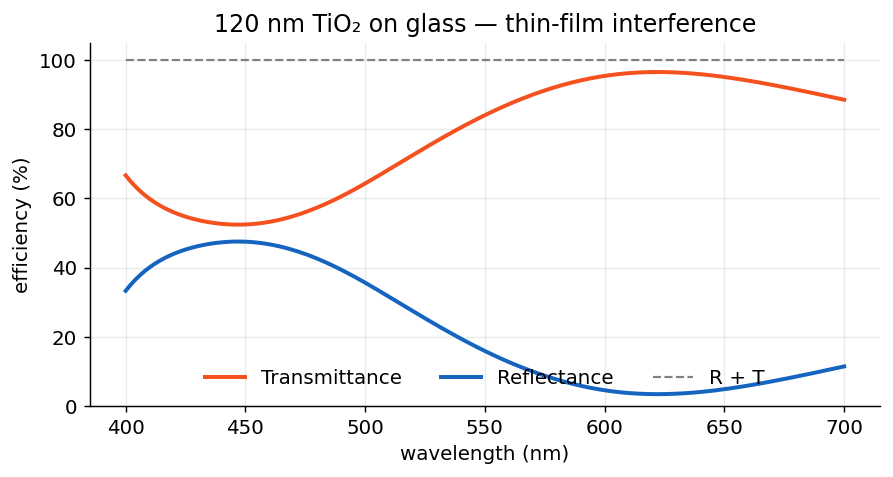
A 120 nm TiO₂ film on glass, swept across the visible. Nothing is patterned,
so only the specular lane exists and RCWA reproduces the exact transfer-matrix
spectrum — at n_orders=0, which makes it effectively free:
import numpy as np
from ikarus import RCWA

rcwa = RCWA(period_x=400e-9, period_y=400e-9, n_orders=0)  # specular only
rcwa.add_uniform_layer(np.inf, "Air")
rcwa.add_uniform_layer(120e-9, "TiO2")
rcwa.add_uniform_layer(np.inf, "SiO2")

wavelengths = np.linspace(400e-9, 700e-9, 61)
R, T = [], []
for wl in wavelengths:
    rcwa.set_source(wavelength=wl, theta=0, polarization="linear")
    _, _, res = rcwa.simulate()
    R.append(res.R_total)
    T.append(res.T_total)

R, T = np.array(R), np.array(T)
print(f"R+T spans [{(R+T).min():.6f}, {(R+T).max():.6f}]")  # ≈ 1: lossless here
Why n_orders=0 is not cheating
A uniform stack has no pattern to diffract from — one harmonic (the specular order) captures the physics exactly. Save the big harmonic budgets for patterned layers; thin films fly free.
Plot it
import matplotlib.pyplot as plt

fig, ax = plt.subplots(figsize=(7, 4))
ax.plot(wavelengths * 1e9, R * 100, label="Reflectance")
ax.plot(wavelengths * 1e9, T * 100, label="Transmittance")
ax.plot(wavelengths * 1e9, (R + T) * 100, "k--", lw=1, label="R + T")
ax.set_xlabel("wavelength (nm)")
ax.set_ylabel("efficiency (%)")
ax.legend(); ax.grid(alpha=0.3)
fig.savefig("thin_film_spectrum.png", dpi=150, bbox_inches="tight")
Totals vs. the specular lane
R_total/T_total sum over all propagating orders. For patterned
structures you'll often want just the straight-through lane:
i00 = res.order_index(0, 0)
print("specular T(0,0) =", res.T_orders[i00])
print("specular R(0,0) =", res.R_orders[i00])
For this thin film they coincide — there is only the one lane.
Absorption: when R + T honestly isn't 1
Put 50 nm of gold in the path and watch the energy ledger:
rcwa = RCWA(period_x=400e-9, period_y=400e-9, n_orders=0)
rcwa.add_uniform_layer(np.inf, "Air")
rcwa.add_uniform_layer(50e-9, "Au")          # gold: a glutton in the visible
rcwa.add_uniform_layer(np.inf, "SiO2")

rcwa.set_source(wavelength=550e-9, theta=0, polarization="linear")
_, _, res = rcwa.simulate()
A = 1.0 - res.energy_balance
print(f"R={res.R_total:.3f}  T={res.T_total:.3f}  A={A:.3f}")
A is real ohmic loss, not an error. The diagnostic rule:
energy_balance reads… |
Verdict |
|---|---|
| ≈ 1 (lossless materials) | converged, healthy |
| < 1 (lossy materials) | absorption — physics, working as intended |
| ≳ 1.01 (lossless) | unconverged — raise n_orders |
| ≫ 1 | numerical trouble — see Troubleshooting |
Expected results
- TiO₂/glass: smooth interference fringes;
R+T ≈ 1to ~10⁻⁹. - Au film: a real
A(≈0.27 here),R+Twell below 1 — gold doing gold things.
Pilot habits
n_orders=0for thin films — exact and instant.- One
RCWA, manyset_source(wavelength=...)calls — never rebuild a fixed stack inside a sweep. - Glance at
energy_balanceafter every new structure. It's the cheapest bug detector in photonics.