Lesson 5 · Twisting Light
Mission: rotate linear polarization across an anisotropic meta-atom, speak the co/cross language of circular light, and put a number on chirality.
Rotating linear polarization
linear_pol_angle measures from TE: 0 = TE/s, 90 = TM/p. At normal
incidence that's simply the E-field direction in the xy-plane (0 → +y,
90 → +x). A nanobar — longer than it is wide — responds differently along its
two axes (form birefringence):
import numpy as np
from ikarus import RCWA, shapes

period, N = 500e-9, 96
bar = shapes.rectangle(center=(0.5, 0.5), size=(0.7, 0.25), grid_shape=(N, N))

rcwa = RCWA(period_x=period, period_y=period, resolution=(N, N), n_orders=(9, 9))
rcwa.add_uniform_layer(np.inf, "Air")
rcwa.add_layer(220e-9, bar, ["Air", "Si"])   # a Si nanobar
rcwa.add_uniform_layer(np.inf, "SiO2")

angles = np.linspace(0, 180, 37)
T = []
for psi in angles:
    rcwa.set_source(wavelength=700e-9, theta=0, polarization="linear", linear_pol_angle=psi)
    T.append(rcwa.simulate()[2].T_total)

T = np.array(T)
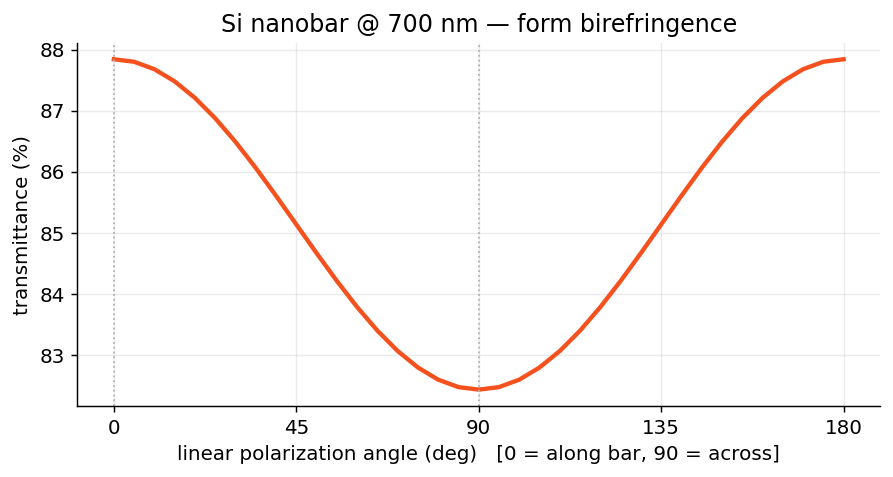
print(f"T swings from {T.min():.3f} (across the bar) to {T.max():.3f} (along it)")

# plot transmittance vs. polarization angle
import matplotlib.pyplot as plt
plt.figure(figsize=(7, 4))
plt.plot(angles, T * 100, lw=2)
plt.axvline(0, color="0.7", ls=":"); plt.axvline(90, color="0.7", ls=":")
plt.xlabel("linear polarization angle (deg)  [0 = along bar, 90 = across]")
plt.ylabel("transmittance (%)")
plt.title("Form birefringence of a Si nanobar"); plt.grid(alpha=0.3)
plt.tight_layout(); plt.savefig("polarization.png", dpi=150, bbox_inches="tight")
plt.show()
Expect a 180°-periodic oscillation with extrema at 0°/90° — the bar acting as a tiny waveplate. This is exactly how geometric-phase metasurfaces are born.
Circular light: the co/cross dialect
Under RCP/LCP illumination, T and R come back as dicts
{"co", "cross"} — the part that kept the incident handedness and the part
that flipped it. They're complex amplitudes, normalized so
\(|co|^2 + |cross|^2\) equals the zero order's efficiency:
rcwa.set_source(wavelength=700e-9, theta=0, polarization="RCP")
T, R, res = rcwa.simulate()
print(f"T_co={abs(T['co'])**2:.3f}  T_cross={abs(T['cross'])**2:.3f}")
print(f"R_co={abs(R['co'])**2:.3f}  R_cross={abs(R['cross'])**2:.3f}")
The anisotropic bar converts some handedness (that's its waveplate nature). A symmetric disk wouldn't. And a structure with genuinely broken mirror symmetry — an L, a gammadion — treats the two handednesses unequally.
Putting a number on chirality
Circular dichroism (CD): does the structure transmit RCP and LCP differently?
def total_T(pol):
    rcwa.set_source(wavelength=700e-9, theta=0, polarization=pol)
    return rcwa.simulate()[2].T_total

CD = total_T("RCP") - total_T("LCP")
print(f"circular dichroism CD = {CD:+.4f}")
For the achiral bar: CD ≈ 0 to numerical precision — a free correctness
check. Break the in-plane mirror symmetry (or go oblique / stack layers) and
CD wakes up.
Designing for polarization
The inverse module speaks this dialect natively:
Target.maximize("t_cross", ...) breeds a polarization converter,
Target.match("t_phase", value, ...) pins a phase, and
MetaAtom(..., polarization="RCP") sets the illumination for the whole
evolution.
Expected results
- Nanobar transmittance oscillates with 180° period; extrema on its axes.
- Achiral structure →
CD ≈ 0. If it isn't, that's a finding (or a typo in your topology).
Pilot habits
- Calibrate with a boring case first: an isotropic slab must be blind to
linear_pol_angleand haveCD = 0. co/crossare amplitudes — square for power,np.anglefor phase.- Step 6 of
python -m ikarus.examples.feature_touris this lesson, live.