Lesson 3 · Sculpting Wavefronts
Mission: build a 2-D meta-atom from shape primitives, harvest the transmission phase (the metasurface designer's currency), and look at the near field with your own eyes.
A dielectric nanopillar
A square lattice of TiO₂ cylinders on glass — the canonical building block of visible-light metalenses:
import numpy as np
from ikarus import RCWA, shapes

period = 420e-9
N = 128
pillar = shapes.circle(center=(0.5, 0.5), radius=0.32, grid_shape=(N, N))

rcwa = RCWA(period_x=period, period_y=period, resolution=(N, N), n_orders=(10, 10))
rcwa.add_uniform_layer(np.inf, "Air")
rcwa.add_layer(600e-9, pillar, ["Air", "TiO2"])   # 0 -> Air, 1 -> TiO2
rcwa.add_uniform_layer(np.inf, "SiO2")
rcwa.set_source(wavelength=532e-9, theta=0, polarization="linear")

_, _, res = rcwa.simulate()
print(f"T={res.T_total:.3f}  R={res.R_total:.3f}  R+T={res.energy_balance:.5f}")
See what you built:
rcwa.visualize_structure(plane="xz", savefig="stack.png")          # the stack
rcwa.visualize_structure(plane="xy", layer_index=1, savefig="topology.png")
Phase: the designer's currency
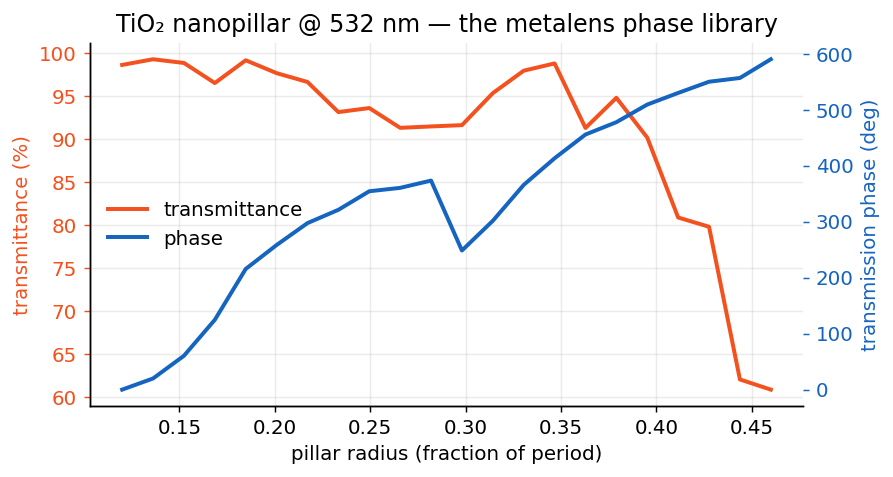
A metalens is a map from position to phase delay. You build it from a library of pillars whose radius tunes the transmission phase of the specular order — ideally covering a full \(2\pi\) while staying transparent:
radii = np.linspace(0.15, 0.45, 25)
T, phase = [], []
for r in radii:
    pillar = shapes.circle(radius=r, grid_shape=(N, N))
    rcwa = RCWA(period_x=period, period_y=period, resolution=(N, N), n_orders=(10, 10))
    rcwa.add_uniform_layer(np.inf, "Air")
    rcwa.add_layer(600e-9, pillar, ["Air", "TiO2"])
    rcwa.add_uniform_layer(np.inf, "SiO2")
    rcwa.set_source(wavelength=532e-9, theta=0, polarization="linear")
    _, _, res = rcwa.simulate()
    T.append(res.T_total)
    phase.append(res.T_phase)             # zero-order phase, radians

phase = np.unwrap(phase)
print(f"phase coverage: {np.degrees(np.ptp(phase)):.0f} deg "
      f"(a full library wants >= 360)")

# plot the phase library: transmittance and phase vs. radius (twin axes)
import matplotlib.pyplot as plt
fig, ax1 = plt.subplots(figsize=(7, 4))
ax2 = ax1.twinx()
ax1.plot(radii, np.array(T) * 100, "C1", lw=2)
ax2.plot(radii, np.degrees(phase), "C0", lw=2)
ax1.set_xlabel("pillar radius (fraction of period)")
ax1.set_ylabel("transmittance (%)", color="C1")
ax2.set_ylabel("transmission phase (deg)", color="C0")
fig.tight_layout(); fig.savefig("phase_library.png", dpi=150, bbox_inches="tight")
plt.show()
Each pillar is a tiny truncated waveguide; fatter pillar → higher effective index → more phase delay. When the sweep covers \(2\pi\) with \(T \gtrsim 0.9\), you have a complete set of "phase pixels" to tile any wavefront you like.
Near-field maps
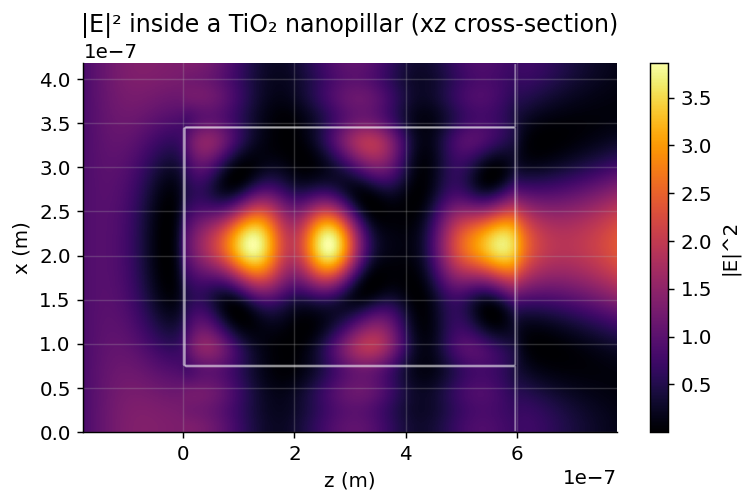
Numbers are good; seeing the Mie resonance inside the pillar is better:
from ikarus.visualization import plot_field

rcwa.set_source(wavelength=532e-9)
rcwa.simulate()

# xz cross-section through the pillar center:
xz = rcwa.get_fields(plane="xz", nx=160, y_position=period / 2)["xz"]
ax = plot_field(xz, component="intensity")          # |E|² + structure outline
ax.figure.savefig("pillar_field_xz.png", dpi=150, bbox_inches="tight")

# xy slice at mid-height:
xy = rcwa.get_fields(z_positions=[300e-9], plane="xy", nx=160, ny=160)
ax = plot_field(list(xy.values())[0], component="intensity")
ax.figure.savefig("pillar_field_xy.png", dpi=150, bbox_inches="tight")
The plots come with the material outline overlaid automatically, so you can check the field actually lives where you think it does.
Too lazy to sweep radii? Good.
Declaring the goal and letting a genetic algorithm sculpt the meta-atom is a one-liner away — see Inverse Design and the broadband AR coating in The Hangar.
Expected results
- High transmittance (
T ≳ 0.9) away from resonances, with dips at the pillar's Mie resonances. - A phase ramp vs. radius spanning ≥ 360° for a well-chosen height — your metalens alphabet.
Pilot habits
- Keep the period subwavelength in the substrate (
period < λ/n_sub) so no stray diffraction lanes open — all the power stays in the specular order you're phase-engineering. n_orders8–12 is the dielectric-pillar sweet spot; confirm with Lesson 4's convergence ritual.- Reconstruct fields on a finer
nx/nythan the solverresolution— the reconstruction grid is free to choose.